
The Health Benefits of Microgreens
Microgreens are young vegetables harvested within about ten days of sowing, when their flavour and nutrient density are at their peak.

Nutrient Dense
More vitamins and minerals per gram than the mature plant, so a small handful counts.

Good for Digestion
Fibre supports regular digestion, and raw greens bring living enzymes to the plate.

Antioxidant Rich
Young greens are loaded with the antioxidant compounds that give them their colour and bite.

Supports Bone Health
Vitamin K and calcium work together in bone mineralization. Leafy greens are among the best dietary sources of both.

Supports Heart Health
Fibre, potassium and vitamin K all play a role in keeping the cardiovascular system running well.

Supports Immune Function
Vitamins A & C, plus the zinc found in sunflower shoots, all contribute to a normally functioning immune system.
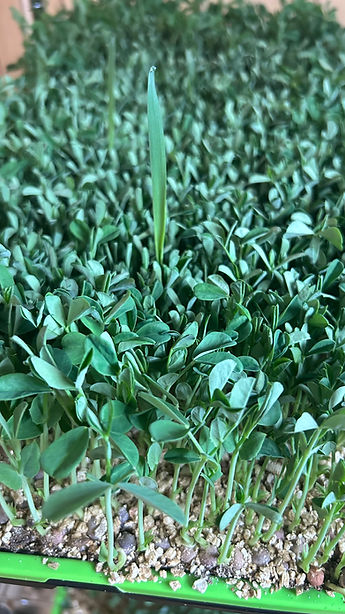
Pea Shoots
Sweet and tender, with the flavour of fresh garden peas. Pea shoots are a source of folate, which the body uses in normal cell division, and vitamin K, which plays a role in normal blood clotting. They also provide fibre along with a spread of B vitamins involved in energy metabolism, and choline, which the body uses in fat transport and liver function.
Contains: Vitamins K, B1, B2, B3, B6, folate, choline, copper, phosphorus, manganese, zinc, iron and potassium

Sunflower Shoots
Nutty, crisp and slightly sweet, with more substance than most microgreens. Sunflower shoots provide all nine essential amino acids, which is uncommon in a leafy green, and their protein and fibre content adds staying power to a meal without weighing it down. A useful addition for anyone building meals around plants.
Contains: Protein with all nine essential amino acids, chlorophyll, lecithin, ferulic acid, vitamins A, B1, B2, B3, B5, B6, B7, C, folate, calcium, iron and zinc
Broccoli
Mild and fresh with a gentle peppery finish. Broccoli microgreens are one of the most studied greens we grow, largely because young broccoli plants carry considerably more glucoraphanin than mature heads. Glucoraphanin is the compound the body converts into sulforaphane, which researchers have been investigating for years. They also contribute calcium and potassium, both of which the body uses to maintain normal bones and mineral balance.
Contains: Glucoraphanin, calcium, manganese, phosphorus, potassium, magnesium and selenium


Arugula
Peppery, bright and assertive. Arugula is a notable source of vitamin K, which the body uses in bone mineralization and in regulating how calcium is absorbed and stored. One cup provides roughly 22 micrograms of vitamin K along with about 32 milligrams of calcium, contributing toward the 1,000 milligram daily value for adults. Leafy greens are among the richest dietary sources of vitamin K available.
Contains: Vitamins A, B, C, E and K, folate, iron, calcium, magnesium and potassium
Red Radish
Sharp, spicy and vivid. Radish microgreens are rich in glucosinolates, the sulphur compounds responsible for their peppery bite and a longstanding subject of nutritional research. Like all our greens they provide fibre, which supports regular digestion, and vitamin E, which acts as an antioxidant in the body.
Contains: Vitamins A, C, E, B6 and B9, potassium, magnesium, calcium and iron

